
A New Kind of Architect
For centuries, architecture has been guided by human intuition — sketches, blueprints, and the personal vision of the architect. Now, artificial intelligence is quietly stepping into that role, not to replace creativity but to expand it.
AI can now generate entire building concepts in seconds, simulate thousands of climate scenarios, and optimize every structural element for strength, energy efficiency, and cost. What used to take teams of specialists months can now happen in hours.
From Imagination to Computation
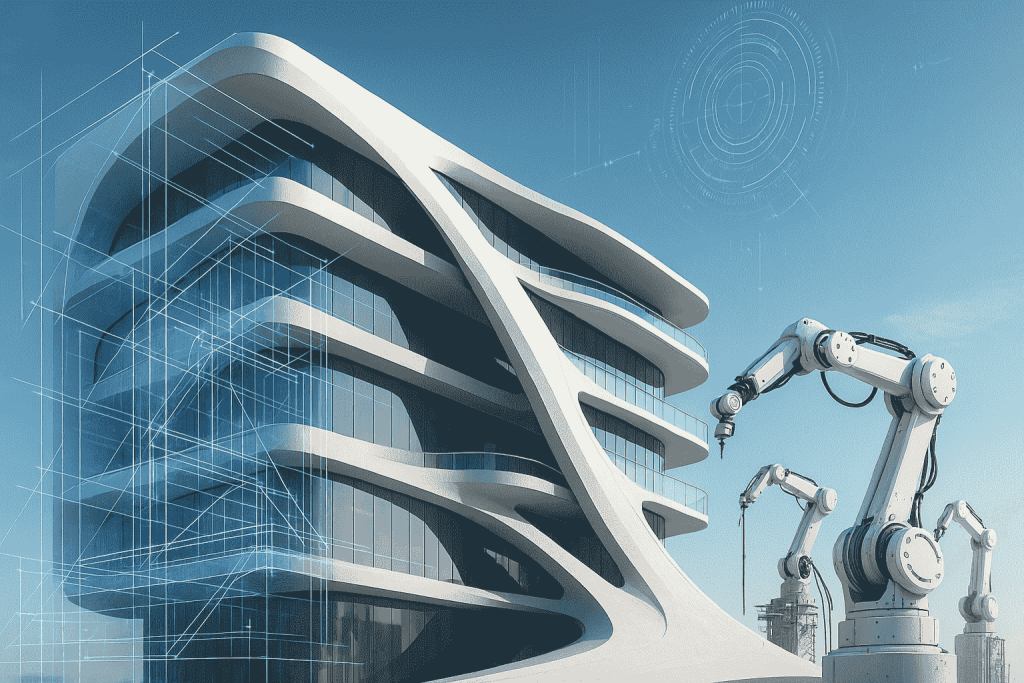
Modern AI design platforms no longer just “assist” — they create. Trained on millions of architectural forms and environmental datasets, they can predict which layouts will maximize natural light, airflow, and energy performance before construction even begins.
For example, neural networks can instantly adapt a house plan to a new site, adjusting foundation depth for soil density and roof angles for solar exposure. In Florida’s fast-changing construction landscape, these capabilities are becoming indispensable.
Generative Design: The End of the Single Solution
Traditionally, architects proposed one vision — one design. AI breaks that model by generating hundreds of variations, each optimized for a specific goal: sustainability, cost, or aesthetics.
The architect no longer selects the only solution but the best compromise among many data-driven options. This marks a philosophical shift: architecture becomes a process of discovery guided by algorithms.
Generative design tools like Autodesk Forma or Midjourney’s architectural engines are already reshaping workflows. They merge art with analytics, turning architecture into a living conversation between human intuition and computational reasoning.
AI on the Construction Site
Artificial intelligence does not stop at the drawing board. On modern construction sites, it predicts delays, manages logistics, and coordinates robotic equipment. Drones scan building progress and compare it to 3D models, detecting millimeter-scale deviations.
In Florida, where weather volatility and coastal regulations complicate building schedules, AI-driven systems are saving weeks of work and significant costs. Learn more about intelligent building materials and how new forms of concrete are transforming architecture. Predictive analytics also enhance worker safety by identifying risk zones before incidents occur.
Learning from the Environment
The future of AI architecture is not only about automation — it’s about adaptation. Smart buildings now use real-time data to adjust lighting, airflow, and insulation dynamically. Some can “learn” seasonal patterns and respond to changing humidity and temperature without human input.
In a region like Florida, where heat and storms define design, this adaptability is crucial. A building that can learn is a building that can last. Discover more about climate-adaptive design principles that shape Florida’s most resilient architecture.
Ethics and the Human Element
The question arises: if machines can design, what remains human about architecture?
The answer lies in intent. AI can generate, but it cannot care. It cannot feel the texture of a material or understand how light affects emotion. The architect’s role shifts from drafter to curator — shaping meaning, empathy, and cultural resonance.
The future belongs not to artificial architects but to human-AI partnerships that blend logic with imagination.
A Future Already Under Construction
AI architecture is not a distant dream. It’s being implemented in smart cities, modular housing, and sustainable developments across the globe. Explore AI-powered construction innovations that are redefining how homes are built in Florida. In Florida, developers are beginning to integrate AI-powered simulations into every phase — from land analysis to energy modeling.
The blueprint of the future is no longer drawn by hand; it is computed, refined, and optimized in real time.
The result: buildings that not only stand but think.
 English